
Top AI Search Visibility Optimization Strategies to Future-Proof Your Content


Like always, search is changing.
Not long ago, SEO success meant getting to page one on Google. Today, AI-powered search tools like Google’s AI Overviews, Perplexity, and ChatGPT are changing the game.
These new tools explain, summarize, and even recommend sources without requiring users to click through.
So, how can your business stand out?
By mastering AI search visibility optimization (blending the best of SEO with strategies that help AI understand and highlight your content). In this guide, we’re walking you through the top AI search visibility optimization strategies you can use to keep your content discoverable and trustworthy as search keeps evolving.
Let’s take a look.
Highlights
- Use simple structures, semantic keywords, and schema markup to help AI understand and cite your content.
- Build trust with E-E-A-T, fresh updates, and consistent branding across the web.
- Add FAQs, images with captions, and audio/video for multi-modal search success.
- Use Trustmary to create helpful reports and original research based on customer reviews.
What is AI search?
AI search means using an AI tool to search for information. The AI interprets the context and provides a direct answer based on sources such as websites, databases, documents, and verified content it has access to.
It pulls key facts from these sources and combines them into a single, clear response.
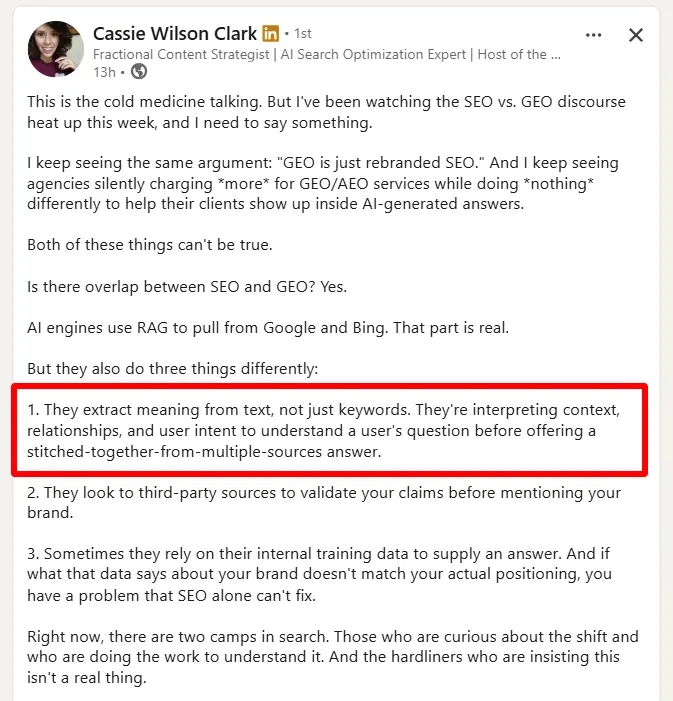
AI search expert, Cassie Wilson Clark says:
“AI engines extract meaning from text, not just keywords. They’re interpreting context, relationships, and user intent to understand a user’s question before offering a stitched-together-from-multiple-sources answer.”
AI tools that help users search include Google Search (with AI Overviews), ChatGPT, Claude, Perplexity AI, and Gemini.
Note: The information AI search generates may or may not be accurate.
What is AI search optimization?
AI search optimization focuses on shaping your content (and content strategy) so AI tools can include you in their answers. This means your brand could get quoted, cited, or mentioned directly by AI.
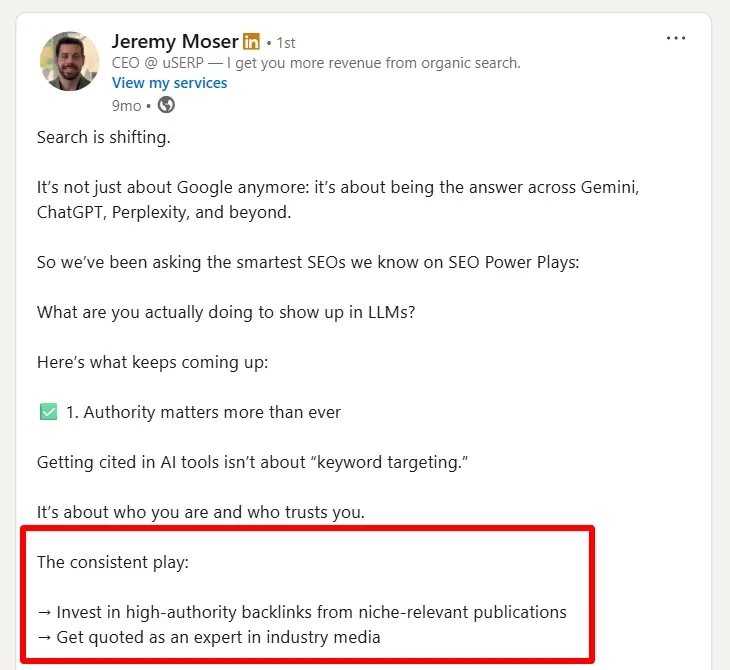
Authority, structured content, and original insights increase your chances of being picked up, according to SEO expert Jeremy Moser.
Jeremy mentions that “authority matters more than ever” and recommends:
- Investing in high-authority backlinks from niche-relevant publications.
- Getting quoted as an expert in industry media.
More on authority in a bit!
What’s the difference between SEO optimization and AI search optimization?
SEO optimization helps your site become discoverable by web crawlers. AI search optimization helps your brand get selected, referenced, and cited by generative AI models when they answer questions.
With the basics out of the way, here are the top AI search visibility optimization strategies to future-proof your content:
1. Focus on topic clusters in your specific niche
AI search tools group related ideas and try to understand why people are asking. That’s why focusing on main and semantic keywords (words connected by meaning and context) is so important.
Here’s how to implement this strategy:
- Conduct primary keyword research. Research low-competition keywords you can target relevant to your target audience. Micro-intent queries are great because they’re highly specific to your audience but usually less competitive. *Pro-Tip: Focus on evergreen topics that continue to attract traffic over time.
- Identify user intent for each main topic. Are users learning (informational), buying (transactional), or finding something (navigational)? Use this information to tailor your content to funnel stages. E.g., informational keywords will target top-of-the-funnel users.
- Research secondary keywords. Use a semantic keyword research tool, like Frase, to pull semantic keywords for each main topic.
- Use AI tools like Ahrefs and Semrush to explore gaps in competitors’ content. Make a plan to fill in the gaps and strategize ways to make your content even better than theirs.
- Map primary and secondary topics for each page. Plan pillar content for parent pages and supporting content for child pages.
- Choose one main keyword and two to three related subtopics for each article. Include semantic variations (pulled from a tool like Frase) naturally in headings and body text.
- When writing, use natural language. Answer related questions that could show up in multi-turn AI chats. Use all of these notes to create detailed content briefs so your writers know what you’re aiming for.
- Interlink your parent and child pages to create your “topic clusters.” (After you’ve published your content on your website.)
The best part of using this strategy?
Topic clusters improve rankings in traditional search engines AND make content more discoverable and citable by LLMs. A win-win.
*Pro-Tip: Repurpose content from your blog post topic clusters and distribute across your other marketing channels.
2. Structure your content to help AI identify relationships between topics and improve snippet eligibility
A clear structure helps both readers and AI models.
Think of it like giving search engines and AI systems a roadmap.
Here’s what to do:
- Format your articles properly. Use an H1 for your main topic, H2s for main ideas, and H3s for subtopics.
- Use question-based headers after your blog introductions. (They mirror how people speak in chat or voice search.)
- Keep paragraphs short and use bullet points to make scanning easy.
- Add tables or steps when explaining processes. Visuals help AI grasp relationships between ideas.
- Add a quick “Highlights” section at the top of your post. This helps readers scan key points and tells AI what’s important. See ours above.
- Wrap up every post with an FAQ section, where you answer common search queries around your main keyword. This is gold for both snippets and AI Overviews.
3. Implement proper schema markup
Schema markup tells search engines and AI tools what your content is about. It’s like labeling your content with digital tags so AI can understand it faster.
Use these common types:
- Product: For product pages, e.g., ecommerce products.
- FAQPage: For your question and answer sections.
- Review: For star ratings and reviews.
- Article: For blog posts or resources.
- HowTo: For step-by-step guides.
- VideoObject: For video content.
- Author: For author bios.
Schema markup can help your content appear in rich results, featured snippets, and AI answers.
4. Build authority in your industry
When AI pulls answers from the web, it looks for sources it can trust. Authority signals tell both search engines and AI that your brand is worth citing.
AI models pull from multiple sources at once rather than ranking pages in isolation. A brand that shows up consistently across trusted publications carries more weight than one with a single high-authority backlink. Frequency and spread across relevant domains matter more than any one link.
Here’s how to build that trust:
- Implement a backlink strategy. Get your brand mentioned on respected sites through digital PR, guest posts, and collaborations. (Remember what Jeremy said!)
- Include natural links back to your social profiles and about pages so AI can confirm your identity.
- Keep your author bios consistent across all of your content and marketing channels.
Authority isn’t built overnight, but every backlink and mention strengthens your credibility in AI eyes. Just like it does with SEO.
5. Demonstrate E-E-A-T in your content
E-E-A-T stands for Experience, Expertise, Authoritativeness, and Trustworthiness.
And it’s another key to earning both search rankings and AI mentions.
To demonstrate E-E-A-T in your content:
- Mention your own relevant experience and credentials.
- Link to reputable sources and original research.
- Add case studies, customer reviews, or quotes.
- Focus on content depth and actionable insights.
- Use internal links to connect related pages.
- Include images to “show, not tell.”
Reviews feed directly into how AI search tools assess credibility. When these systems evaluate a brand, they often pull signals from third-party platforms like G2 or Trustmary alongside what’s on the site itself. Adding structured review schema, embedding verified customer reviews, and pointing to real feedback in your copy gives AI-generated answers something concrete to cite.
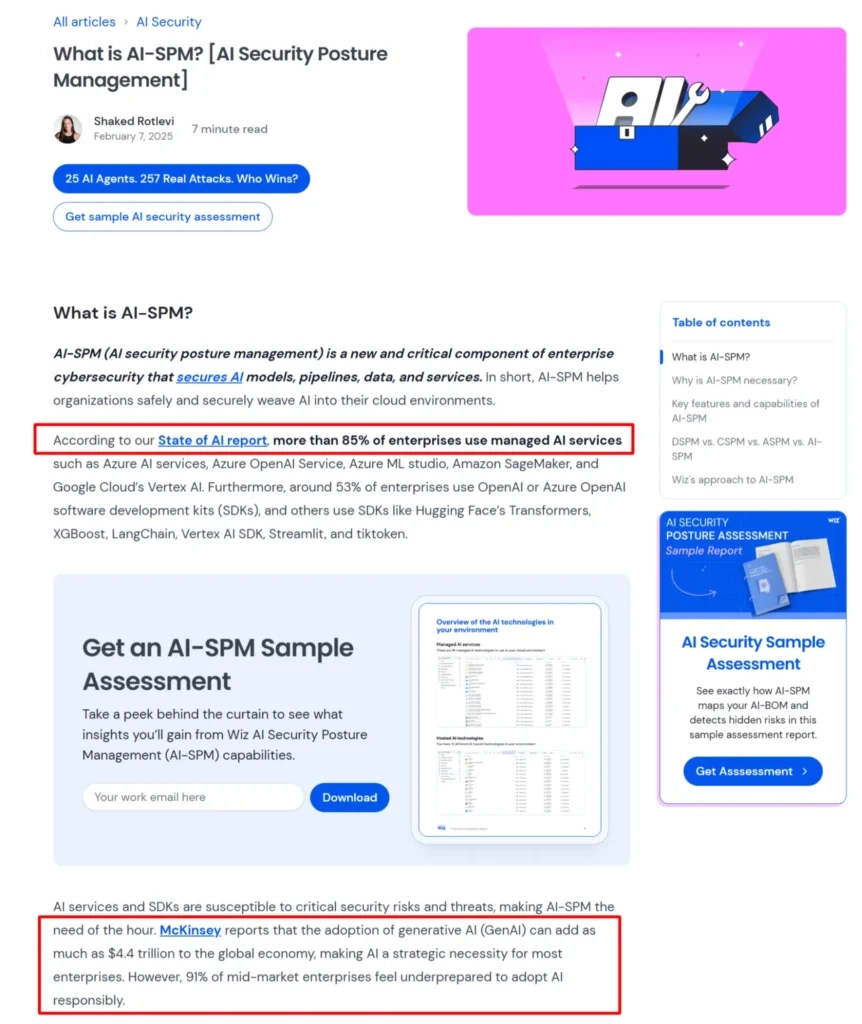
Take a look at the following piece on AI security posture management by Wiz. It references its own State of AI report and research from McKinsey (a highly trusted source). In fact, the entire piece has references, examples, and images to demonstrate Wiz’s industry expertise.
*Pro-Tip: Check out Trustmary’s insights solution. This feature can help you turn customer feedback into credibility-rich content, like case studies and original reports.
6. Implement an everywhere SEO strategy
AI-powered search also learns from your overall brand presence across the web, not just your website.
That’s why you need an everywhere SEO strategy. Consistency helps AI systems understand your brand’s full identity.
But external consistency starts with internal alignment. Search visibility is also about how organizations manage internal knowledge.
Intranet software serves as a central hub where teams share research, SEO insights, and content performance data, making it easier for marketing, editorial, and technical teams to collaborate on search strategies.
Instead of scattered documents and disconnected channels, these tools keep resources organized and accessible. Teams can quickly review past campaigns, keyword research, and content guidelines when planning new content. When teams work from the same guidelines and positioning documents, what they publish across channels reflects that.
Keep your brand descriptions, product positioning, and messaging consistent across your website, LinkedIn, guest posts, and directory listings. When those signals conflict, AI systems have less to work with and are less likely to cite you accurately.
To make this work:
- Keep your brand voice and visuals consistent across all platforms.
- Use the same language when describing your products or services.
- Strengthen cross-channel links (from your blog to your LinkedIn and partner mentions).
AI models will start recognizing your business as a single, unified entity, making it easier to include your content in summaries, recommendations, and overviews.
7. Refresh content to stay relevant
AI models learn from fresh content. If your posts haven’t been updated in a year or two, you’re missing visibility opportunities.
Set a schedule to review your key content every three to six months.
During refreshes:
- Fix broken links and formatting.
- Replace outdated references.
- Update stats and examples.
- Refresh your images.
- Add new insights.
Freshness helps SEO rankings and tells AI engines that your brand stays active and accurate.
8. Optimize for multi-modal AI search
AI analyzes text, visuals, audio, and video together when deciding what to show.
To stay relevant across formats:
- Embed short clips or add audio versions to article pages for listening.
- Include descriptive captions for images and transcripts for videos.
- Add alt text for all images. Explain what’s shown and why it matters.
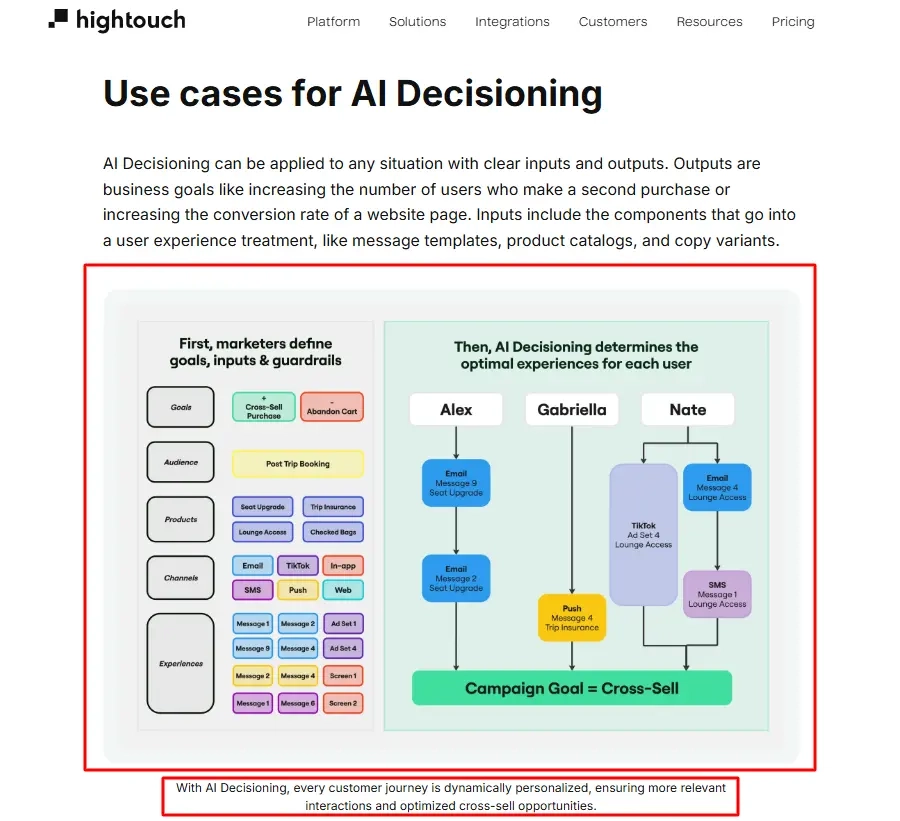
Here’s an example from Hightouch’s blog post on AI decisioning. The following image demonstrates AI decisioning use cases.
Below the image, there’s a descriptive caption that reads: “With AI Decisioning, every customer journey is dynamically personalized, ensuring more relevant interactions and optimized cross-sell opportunities.”
Wrap up
AI and SEO aren’t competitors. They’re partners. SEO helps people discover your content. AI search helps them understand and trust it.
To future-proof your visibility, focus on clarity, structure, and trust. Use schema markup, consistent branding, and credible references. Keep your content fresh and accessible across formats.
Before you start, measure where you stand. A free AI visibility report from Trustmary shows how often ChatGPT, Gemini, Claude and Google AI Overviews mention your business, which competitors come up and why, and recommended actions in priority order.
Apply these top AI search visibility optimization strategies now, and your content will stay relevant — no matter how smart search engines become.
P.S. Want to turn your customer feedback into social proof and boost trust signals? Try Trustmary to make your best content even stronger.
FAQs: Optimizing for AI search
How to optimize your content for AI search?
To optimize your content for AI search, write clear, helpful answers to real user questions. Use semantic keywords (related phrases that share meaning) so AI tools can easily identify your topic.
Add structured headings, bullet lists, and schema markup (like FAQ or HowTo). Keep content accurate, up to date, and easy to read. AI prioritizes trustworthy sources over generic content.
Top ways to ensure your content performs well in Google’s AI experiences on Search?
Show authority through E-E-A-T (Experience, Expertise, Authoritativeness, Trustworthiness). Add FAQs and short summaries, too — AI loves pulling those for answer boxes.
Make sure to also use schema markup and descriptive image captions. (These steps work for both traditional search and AI Overviews.)
Will SEO be replaced by AI?
No, AI won’t replace SEO, it enhances it. SEO gets your pages found and indexed. AI helps your brand get cited in generated answers. You need both: SEO for visibility, AI-friendly content for citations. The future is SEO and AI working together.
Will SEO exist in 5 years?
Yes, but it will evolve. SEO won’t disappear; search engines will always need to understand, index, and rank content.
How do I track if my content appears in AI search results?
Check Google Search Console for AI Overview impressions and track mentions in tools like Ahrefs AI Overview Tracker or Semrush Position Tracking. You can also test your content directly. (Ask Perplexity, ChatGPT, or Gemini questions with your target keywords to see if your brand or pages get cited.) For a one-time measurement across ChatGPT, Gemini, Claude and Google AI Overviews, get a free AI visibility report from Trustmary.
Should I create content just for AI search or stick to regular SEO?
Don’t choose … do both together. AI search loves the same qualities as good SEO: Clear structure, trustworthy sources, fresh updates, and helpful answers. Write human-first content that ranks well traditionally and gets cited by AI. The strategies overlap 80% of the time.
E.g., Semantic keywords, schema markup, E-E-A-T, and topic clusters work for Google rankings and AI Overviews. Focus on quality content that serves real users across all platforms.