
AI Visibility Guide for Growth Companies


Remember when we used to think about AI just as tools to boost productivity and content creation? Those days are long gone.
Now, AI is the new middleman between businesses and customers. The first point of contact with a brand is not a Google search or a web page, but an AI-assisted response, summary, or recommendation.
AI is a whole new channel for customer acquisition. ChatGPT, Gemini, Perplexity, and Google's AI Mode are some examples of AI tools that are acting as search engines for an increasing number of consumers.
For growth companies, this means one thing: visibility and trust are created differently than before. AI will not judge companies on advertising promises, but on their actual digital footprint. Customer reviews, feedback, and experience data have taken centre stage.
This article gives you an overview of the most important topics that growth companies should know about AI visibility.
AI is a whole new channel for customer acquisition. It's no longer just a marketing tool, but a way for customers to find products and services.
What Is AI Visibility?
AI visibility – also called brand discoverability in AI search – refers to how often and how prominently your brand appears in answers generated by AI-powered search engines like ChatGPT, Google Gemini, Perplexity, and Claude.
Think of it this way: traditional visibility meant ranking on Google's first page. Brand visibility in AI search results means being the brand that AI actually recommends.
When someone asks ChatGPT "What's the best tool for collecting customer reviews?", the AI doesn't show a list of search results. It gives a direct, curated answer, typically mentioning 3-5 brands. If you're not one of them, you're invisible in AI-generated search results.
This is fundamentally different from SEO. There's no page two. There's no "close enough." You're either recommended or you're not. That's why improving brand visibility in AI-driven search results has become one of the most important marketing priorities.
Here's what we know about AI visibility based on 2026 reports from industry experts:
- AI visibility is up to 30 times harder than Google visibility. ChatGPT only recommends 1.2% of local businesses, whereas Google's local results show 35.9% of locations.
- AI search rarely ends in a click. Traffic from AI tools is just the tip of the iceberg when it comes to AI visibility.
- AI recommendations are random in nature. That's why tracking visibility is not as straight-forward as with traditional search engines.
- Rank tracking is not relevant. Instead, you should focus on tracking visibility percentage.
AI Visibility and Organic Visibility Online
Many of you may have noticed a decrease in organic traffic to your website. This phenomenon is largely due to the increase in so-called "zero-click content". Users no longer need to click on a link to read the answer, as Google's AI summary or ChatGPT chat provides the answer right out of the box.
However, this does not mean that organic visibility is a thing of the past. Channels have diversified, and new ways of measuring visibility are being invented.
In addition to search engines, visibility now also means how a company appears:
- AI-assisted searches (e.g. Google's AI Mode)
- chat-based answers (ChatGPT, Gemini, Perplexity)
- recommendations and summaries (Google AI summaries and featured snippets)
AI looks for answers from multiple sources, with an emphasis on clarity, consistency, and reliability.
Companies with a strong and coherent digital footprint are more likely to be featured. This is not achieved through a single optimisation trick, but through long-term content and great customer experience.
The biggest challenge today is how to measure AI visibility. You can see website visitors coming through language templates, but pure visibility without clicks is a more challenging equation.
Key Statistics: The "AI Visibility Gap"
The latest 2026 data reveals a stark reality: appearing in AI recommendations is significantly more difficult than ranking on traditional search engines.
| Metric | Google (Local 3-Pack) | ChatGPT | Gemini | Perplexity |
| Visibility Rate | 35.9% | 1.2% | 11% | 7.4% |
| Avg. Rating Needed | Varied | 4.3 ★ | 3.9 ★ | 4.1 ★ |
- The Difficulty Spike: Achieving AI visibility is 3–30x harder than traditional SEO.
- The Quality Filter: AI models act as "gatekeepers"—if your average rating falls below their threshold (typically 4.0+), your brand may be filtered out of results entirely.
- The Randomness Factor: There is a less than 1% chance of an AI generating the same recommendation list twice.
- The Brand Footprint: It takes approximately 250 unique mentions or publications for an LLM to form a definitive "understanding" of your brand.
AI Visibility vs. Traditional SEO: What Changed?
The rise of optimizing for AI search engines (also called GEO, AEO, AIO or LLMO) doesn't mean SEO is dead. It means SEO alone is no longer enough.
Here's how the two compare:
| Perspective | Traditional SEO (Search Engine Optimization) | AI SEO / GEO (Generative Engine Optimization) |
|---|---|---|
| Main objective | Appear high on search engine results pages | Be mentioned and recommended in AI responses |
| Where visibility is created | Google, Bing and other search engines | ChatGPT, Copilot, Gemini, AI search tools |
| Search type | Keyword-based search | Discussion-based, contextual questions |
| Focus of content | Keywords, search term | Answers, context, expertise |
| Content format | Blogs, landing pages, categories | FAQs, summaries, customer experiences, answers |
| Technical role | Page speed, indexing, structure | Structural content, clarity, machine understandability |
| Signals of confidence | Backlinks, domain authority | Reviews, mentions, customer feedback, sources |
| The importance of reviews | Supports conversions and local SEO | A key signal for trust in AI |
| Optimisation method | Keyword research and content optimisation | Building a big picture for AI |
| The importance of cliques | The click is the main goal | Visibility can be created without a click |
| The content lifecycle | Update regularly | Long-lived, if based on experience |
| Competitive advantage | Good technical and content implementation | Trust, customer focus and verifiability |
| Space in 2026 | Still an important basis | A rapidly growing and differentiating factor |
The key difference? AI systems don't just index your content – they evaluate your brand's authority, credibility, and relevance across the entire web.
They look at reviews, community discussions, expert mentions, and structured data to decide who deserves to be recommended. The content on your own website is no longer sufficient alone. External validation and trust signals like reviews help you get found in AI search.
By mid-2026, every marketing team will track how often their brand appears in AI-generated answers, just as they track web traffic and search rankings today.
Why AI Visibility Creates a Compounding Effect
AI visibility isn't linear. It compounds.
When ChatGPT recommends your brand, users write about that experience. They mention you in blog posts, Reddit threads, and social media. That new content becomes part of the data that future AI models learn from, which makes AI even more likely to recommend you again.
Meanwhile, the opposite is also true. Brands that aren't mentioned stay absent from this cycle. The visibility gap widens every month unless you take action.
Data from Brandi AI shows that brands producing 12 or more new or optimized pieces of content per month achieve up to 200x faster visibility gains compared to those producing just four. Momentum matters: AI algorithms in 2026 increasingly favor recency and citation velocity over pure historical volume.
Start now! The longer you wait to invest in AI visibility, the harder it becomes to catch up.
Best Strategies to Improve Brand Visibility in AI Search Engines
So what actually works? Here are the best practices for increasing brand visibility in AI-generated search results, based on how AI search engine algorithms evaluate and select brands.
1. Improve Brand Authority in AI Search
Brand authority is the single most important factor in AI-driven search results. AI-powered search engines evaluate whether your brand is a recognized, trusted expert in your field.
To improve brand authority in AI search:
- Publish original research and data: AI systems heavily favor first-party insights that others cite
- Contribute thought leadership to respected industry publications and media
- Build topical depth: cover your core topics comprehensively across multiple articles
- Earn expert mentions: get quoted, interviewed, and referenced by other authorities
Don't just publish for volume. Publish content that other people cite. That's the new currency for brand performance in AI-driven search engines.
2. Get Featured in "Best Of" and Comparison Lists
ChatGPT and other AI tools frequently reference content from "best of" lists, comparison articles, and review roundups. If your product appears in articles like "Top 10 Review Platforms" or "Best AI Marketing Tools", you're significantly more likely to be mentioned in AI answers.
Actively seek inclusion in relevant industry lists and comparison sites.
Make sure that these lists are actually valuable and well-built. Proper comparisons, honest evaluations, and a deep understanding of each tool.
3. Leverage Customer Reviews Strategically
This is one of the most underestimated factors. According to a study by Feefo, ChatGPT uses reviews in 58% of its responses, while Perplexity references reviews 100% of the time.
But here's the catch: ChatGPT doesn't have direct access to Google Reviews. It relies on reviews that are visible on your website, third-party platforms, and structured data it can crawl. We'll dive deeper into this in the next section.
4. Engage in Community Platforms
AI models heavily reference discussions from Reddit, Quora, and industry forums. Active, helpful participation in these communities builds authority that AI systems recognize.
Don't just promote – genuinely help. Answer questions, share insights, and build a reputation as a knowledgeable voice in your space.
5. Implement Structured Data and Schema Markup
AI needs to understand your content to recommend it. Structured data (schema markup) acts as a translation layer, making it easy for AI to parse and categorize your information.
Key schema types for AI visibility:
- Review schema: structures customer testimonials so AI can identify and cite them
- Organization schema: clarifies who you are and what you do
- Product schema: describes your offering in a machine-readable format
- FAQ schema: makes your answers directly quotable by AI
6. Allow AI Crawlers Access
This sounds basic, but many companies block AI crawlers without realizing it. Update your robots.txt to explicitly allow bots from OpenAI, Anthropic, Google, and other AI providers. If they can't crawl your site, they can't recommend you.
7. Create Multi-Format Content
Go beyond blog posts. AI systems pull from multiple content types:
- Video content (YouTube): AI may transcribe and reference video content
- Podcasts: mentioned and cited in AI answers
- Infographics: shareable and linkable
- Case studies: concrete proof that AI loves to cite
The more formats you cover, the more surface area you create for brand discoverability in AI search. Each format is another opportunity for AI-powered search engines to find, evaluate, and recommend your brand.
Read an even more in-depth article on AI search visibility optimization strategies, or if you have an online store, check out our AI visibility for ecommerce strategy.
AI Search Visibility Tools: What Are They and Do They Help
AI search visibility tools help you track and improve how often AI platforms recommend your brand. Think of them as the AI equivalent of SEO rank trackers: instead of monitoring Google rankings, they monitor whether AI mentions you when someone asks a relevant question.
The market has exploded in 2025–2026, with over 20 dedicated tools now available — from free checkers to enterprise platforms costing $3,000+/month. They fall into three main categories: monitoring tools that track your brand mentions across AI platforms, GEO (Generative Engine Optimization) platforms that help you actively optimize content for AI engines, and enterprise suites that bundle AI visibility with traditional SEO.
The honest reality? No tool will magically fix your AI visibility. But tracking directional trends is vastly better than flying blind — especially when AI referral traffic converts at 5x the rate of traditional Google organic traffic.
Our complete AI search visibility tools guide reviews every major tool with real pricing, key features, and honest user feedback sourced from G2 reviews, Reddit discussions, and independent testers — so you can choose the right one for your budget and goals.
The Impact of Reviews on AI Visibility
Customer reviews are one of the strongest signals of trust in the age of AI. AI uses user-generated content to understand what a business is really like.
Ratings influence which companies are highlighted by AI, how the brand is described in the responses, and how the overall customer experience is perceived.
The more genuine, timely, and multi-channel reviews a company has, the stronger its AI visibility will be.
The Numbers That Matter
- 15+ reviews: Minimum to generate trust
- 50+ reviews: Optimal credibility threshold where new visitors (and AI) trust your average rating
- 100+ recent reviews: Maximizes your chances of being cited in AI answers
- The average rating of companies recommended by ChatGPT was 4.3 stars. For Gemini, it was 3.9 stars, and for Perplexity, 4.1 stars. Companies with ratings below the average were often omitted from recommendations entirely.
External channels such as the Trustmary profile page also increase brand visibility and at the same time change the nature of the responses: instead of just basic information, language models talk about companies in a more service-oriented and recommendable way when customer reviews are available.
Language models can also provide better and more relevant answers to the user based on the reviews.
See our guide on how to make reviews AI search-friendly and ensure AI tools know about yout great customer experience.
Our Test Results
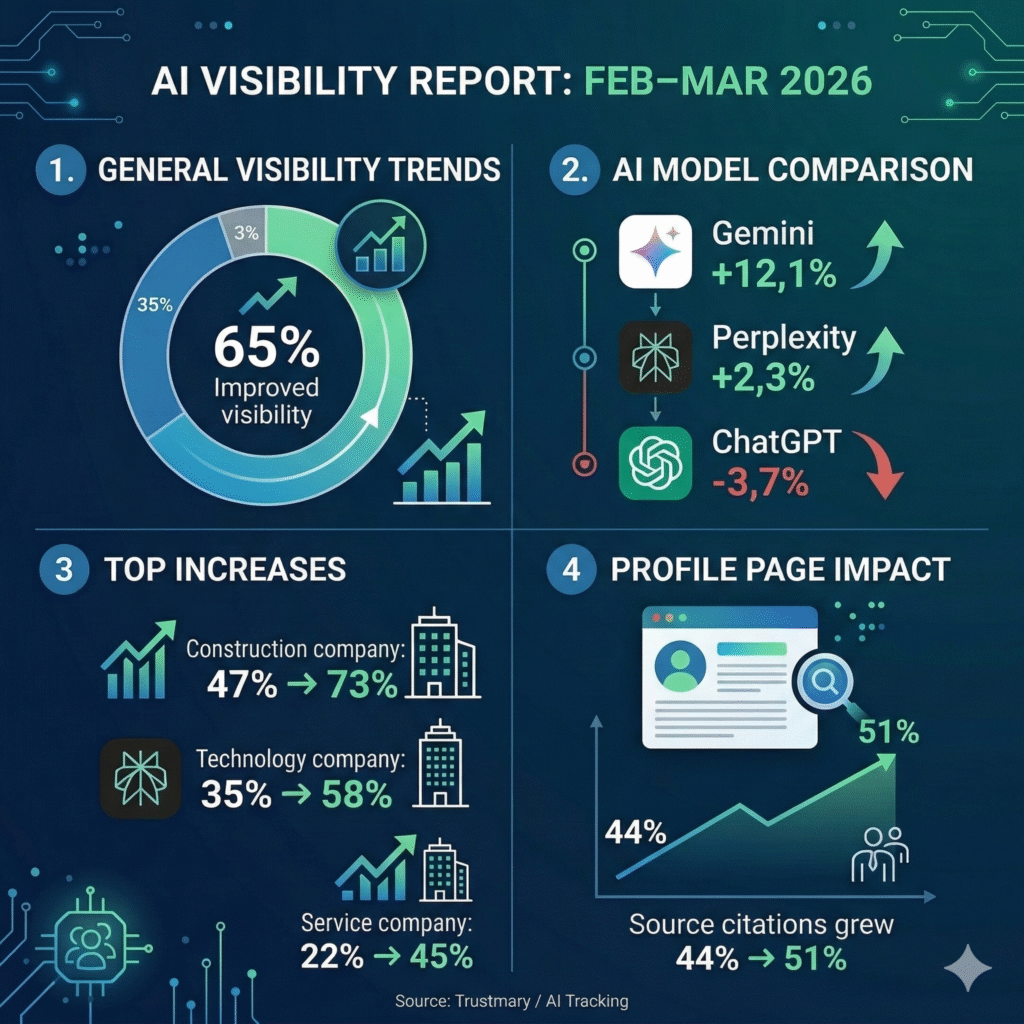
We tested a new Trustmary profile page with over 70 businesses, and found that 65% of them saw an increase in AI visibility.
We noticed that making reviews AI-readable through the Trustmary profile page changes AI mentions in many ways:
- Businesses get mentioned more often.
- In "general searches" (=customers look for information about business categories rather than individual businesses), our customers got better mentions: they were ranked higher.
- AI starts to understand the brands' positioning better, and is able to recommend it to potential customers more accurately.
- In branded searches, AI does not rely on the brand's website alone, but also shows reviews, which means that AI answers provide more social proof to the potential customer.
There are some differences between how various LLMs treat reviews – some models, like Gemini, crawl new pages diligently, and businesses can see drastic visibility increases very fast.
Some others, like ChatGPT, rely on its own training data more, which means that the visibility does not increase steadily, but in bursts – once it crawls a new profile page, it can see dramatic increases in mentions.
Brand Reliability in the Age of Artificial Intelligence
Reliability is a key criterion for evaluating AI. AI seeks to minimise misleading information and favours sources based on real experience.
A trusted brand from an AI perspective:
- does not hide feedback
- shows a complete picture of the customer experience
- base their message on what customers say, not just on promises
For a growth company, this is an opportunity to differentiate itself. Trust does not require a massive budget, but the systematic collection and use of feedback.
Reliability is also built by getting mentions on other sites. The more places your business is mentioned, the more the AI will begin to understand its context and legitimacy.
This is why, for example, taking control of different review platforms will benefit AI visibility.
Customer Data and Feedback to Fuel AI Visibility
Without high-quality data, AI will not provide a competitive advantage. Customer feedback and reviews are often undervalued data that could be very useful both internally and in marketing.
Customer data in internal development
It would take hours for people to go through a large amount of feedback and criticism and then draw up sensible follow-up actions.
AI, on the other hand, can analyse large amounts of open feedback in seconds to identify recurring themes, highlight areas for improvement and support decision-making.
And AI is impartial, unlike humans, who may even resent critical feedback and would prefer to sweep it under the carpet.
With Trustmary, you can compile an unbiased, real-time report on the feedback you receive, providing both numerical and qualitative insights into your customer experience.
Customer data as marketing material
The same feedback also serves as effective marketing content. Traditional methods include adding reviews to the website, sharing them on social media, and presenting relevant testimonials in sales materials.
In the AI era, reviews act as trust signals for language models and provide material to cite in responses. In particular, reviews on third-party sites, such as the Trustmary profile page, are particularly trustworthy and are more likely to appear in searches.
But reviews can also be used as a marketing tool at a more strategic level.
Have you tried feeding AI with all the feedback you've received from customers, and using it to look for ideas and themes for marketing communications, new advertising campaigns, or website development?
Your AI Visibility Action Plan
Improving brand visibility in AI-generated search results isn't optional anymore. By late 2026, there will be a clear divide between brands that AI recommends and brands that are invisible.
Here's your action plan:
- Audit your current AI visibility. Ask AI tools your key customer questions and see where you stand.
- Build authority. Publish expert, data-backed content consistently.
- Get into "best of" lists. Seek inclusion in comparison and roundup articles.
- Collect and display reviews. Aim for 100+ recent reviews with proper schema markup.
- Join the conversation. Engage authentically on Reddit, Quora, and industry forums.
- Fix the technical basics. Implement structured data and allow AI crawlers.
- Go multi-format. Extend your content into video, podcasts, and case studies.
- Monitor brand mentions in AI search. Track what AI says about you and optimize based on results
The biggest mistake you can make right now is waiting. AI visibility compounds over time, and every month you delay makes it harder to catch up.
Start today. Check what AI says about your brand. Then take the first step to change the answer.
An Easy Way to Boost AI Visibility
In the midst of all this information, one question arises from the perspective of a small or medium-sized growth company: where do I start, and how do I get AI visibility up quickly?
We have a solution that requires an hour or two of active time, and within a few weeks you will start to see results.
The Trustmary profile page is a quick and easy way to boost your AI visibility. It allows you to present your entire customer experience in a reliable and transparent way.
Why it works:
- Genuine customer reviews build trust and help language models to recommend your company.
- Trustmary is a reliable source of reviews, which is why it ranks well in both traditional and AI searches.
- You'll get more eyeballs on your brand, and your profile page will redirect you directly to your company's website.
- You will catch keywords such as "[your company] experiences, [your company] reviews", which would otherwise probably lead to discussion forums.
- AI can lift your customers' comments or star ratings directly into their responses to increase trust.
If you've already collected customer feedback and reviews, your page will be up and running in just a few minutes. But if you haven't yet, don't worry: start right away with a bulk collection of dozens or hundreds of feedbacks, depending on the size of your customer base. Then automate the ongoing collection so that you receive new reviews on a regular basis.
Book a demo with us and we'll show you how it works and what kind of results your business can expect.
Artificial intelligence (AI) is the ability of a computer program to perform functions considered intelligent, such as learning, reasoning, observing and problem solving. In everyday language, when we talk about AI, we often refer to AI chats such as ChatGPT or Gemini, but they are only one small part of AI.
Generative AI, as the name implies (generating = creating something new), is AI that can not only observe and analyse, but also create things like text, images, videos, code, and so on.
The language model is a component of generative AI that can interpret and create natural language. ChatGPT, Gemini and Perplexity are examples of tools that use language models. The way language models work is that they analyse the existing data and the given context to find the best combination of words that is desired at any given time.
AI speeds up processes such as content production or data analysis, allowing companies to do more with fewer resources. In addition, AI is now one of the new customer acquisition channels, as people use AI to search for information and recommendations about companies, products and services. Even purchasing can now be done directly through AI agents.
Language models such as ChatGPT search for information about companies not only on their own websites, but also through third parties. All available information about your business can affect your visibility and mentions in AI tools. One easy way is to collect customer feedback and reviews, and display them on your website and on a Trustmary profile page, for example. In addition to this, you should familiarise yourself with LLM optimisation and GEO (generative search optimisation), which can help you improve your website's visibility in AI searches.
Reviews are strong signals of confidence for AI. They tell us about the actual customer experience and help the AI judge whether a company is recommendable. The more quality and timely feedback a business has, the better chance it has of being reflected in AI responses.


