
How reviews affect visibility in AI searches? We tested it

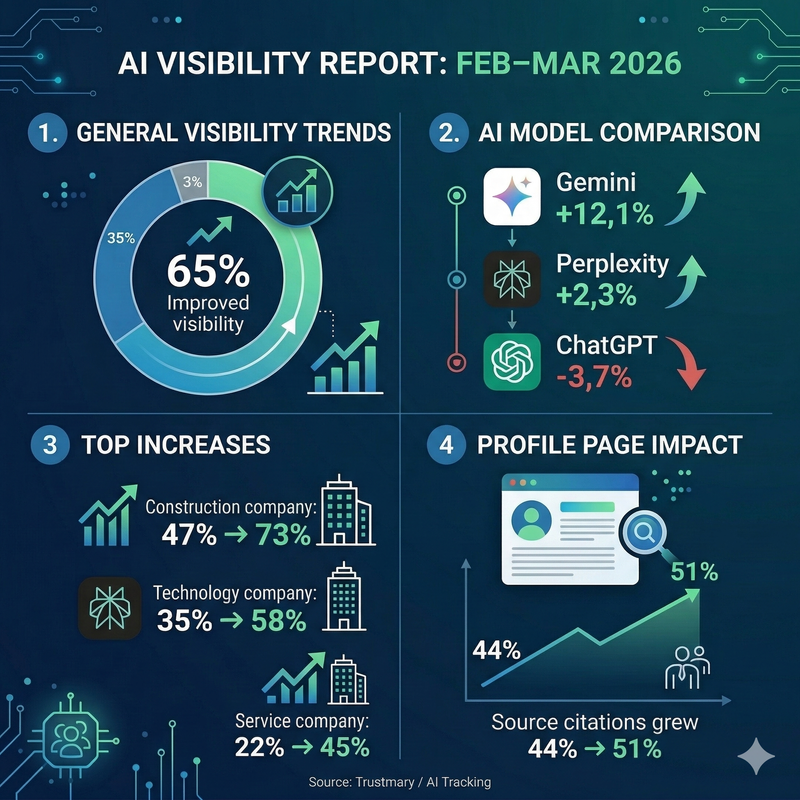
How do reviews affect visibility in AI searches?
We tested this with our customers on Trustmary's new AI-optimised profile page.
In this article, we review the results we have obtained not only from the first pilots, but also more broadly with more than 70 companies in February 2026.
The search will change. Are you ready?
When people search for information, they don't necessarily go to Google anymore. More and more people are turning to AI, or more specifically language models like ChatGPT, Perplexity or Gemini, and asking directly, "What is the best kitchen renovation company in Helsinki?" or "Who should I buy a house package from?"
This is no longer a marginal phenomenon. It is a mainstream behaviour that is growing exponentially.
This change is huge, and most companies have not yet woken up to it.
At Trustmary, we've had conversations with dozens of companies over the past few months, and the situation is almost invariably the same: nothing has been done about AI search performance, and most don't even have an idea of how their company will show up in AI searches.
It will come as a surprise to many that ChatGPT may recommend their competitor, or at worst, not mention them at all.
At the same time, we've been running pilot projects to test how customer reviews and their optimisation affect AI visibility.
The results have been remarkable. In this article, I share them openly. I'll go through what happened in the pilots, why reviews are so critical, and what your company should be doing about it right now.
Why are reviews key in AI searches?
Traditional search engine optimisation focuses on your website: keywords, content, technical implementation and links. Over the years, companies have learned to play by Google's rules, and many are good at it. But AI searches work with a bit of a different logic, and the old lessons don't apply as such.
When ChatGPT or Perplexity answers the question "best company in X industry", it does not just read the companies' own websites. It looks for confirmation of its claims from multiple sources. Customer reviews are one of the most important sources. AI models are trained to recognise that a company's own marketing comms is inherently biased. Therefore, they emphasise third-party validation: reviews, discussion forums, press articles.
AI tools particularly value the following things in content:
- Customer-generated content: reviews, forums, social media posts and comments. This is a third-party endorsement that AI relies on more than the company's own marketing. When a customer writes about their experience in their own words, it's more valuable to AI than polished marketing copy.
- Structured data: clearly structured data from which AI can extract ready-made answers. Lists, tables, scores and statistics are easier for AI to process than long pieces of text. Once the data has been analysed and summarised, the AI does not need to make an interpretation, it can simply refer back.
- Data-driven claims: numbers, facts and concrete examples. When AI can say "4.87/5 average based on 171 reviews", that is a much more convincing answer than "good company". Concrete numbers make the answer more credible and useful to the user.
- New and distinctive data: if content brings new or different data, AI will value it more than generic repetition. That's why authentic customer experiences are valuable: they are unique content that can't be found elsewhere.
- High authority sources: the domain rating of a website affects how much AI trusts its content. Therefore, reviews on a site with a high DR (such as Trustmary, DR 83) carry more weight than reviews on an unknown site.
At the moment, the companies that have already invested in search engine visibility through content are the ones that are doing well in AI searches. But in the future, simply producing content themselves will no longer be enough to compete for visibility. It's the voice of the customer that counts. Those companies with structured, AI-readable reviews will have an advantage.
How we measure AI visibility
The language models rely on their own training data, which is not publicly available, and on searches from traditional search engines (Google, Bing). AI visibility cannot currently be monitored in the same way as, say, traditional Google visibility.
Measuring AI visibility is based on continuous testing.
We have defined a set of prompts for each company we monitor, which we test in different language models on a daily basis. These include both "generic searches" and brand searches.
Generic searches do not directly ask for information about the brand in question, but rather about the service category or local operators. Brand searches, on the other hand, ask explicitly for information about the company in question, and in these cases we pay particular attention to how the AI talks about the company and what sources it cites in its response.
Generated responses provide a picture of trends in mentions over time.
It's important to understand that AI models are stochastic in nature - meaning that the same question may produce a slightly different answer on different days. That's why we don't rely on single points of measurement, but instead monitor daily and report the results as weekly averages that smooth out this random variation.
Extended report: Two thirds of companies increased their discoverability
This section summarises the results of several weeks of AI visibility monitoring (February-March 2026).
A total of 76 companies from different sectors are included in the monitoring. Of these, 37 have been monitored for more than three weeks.
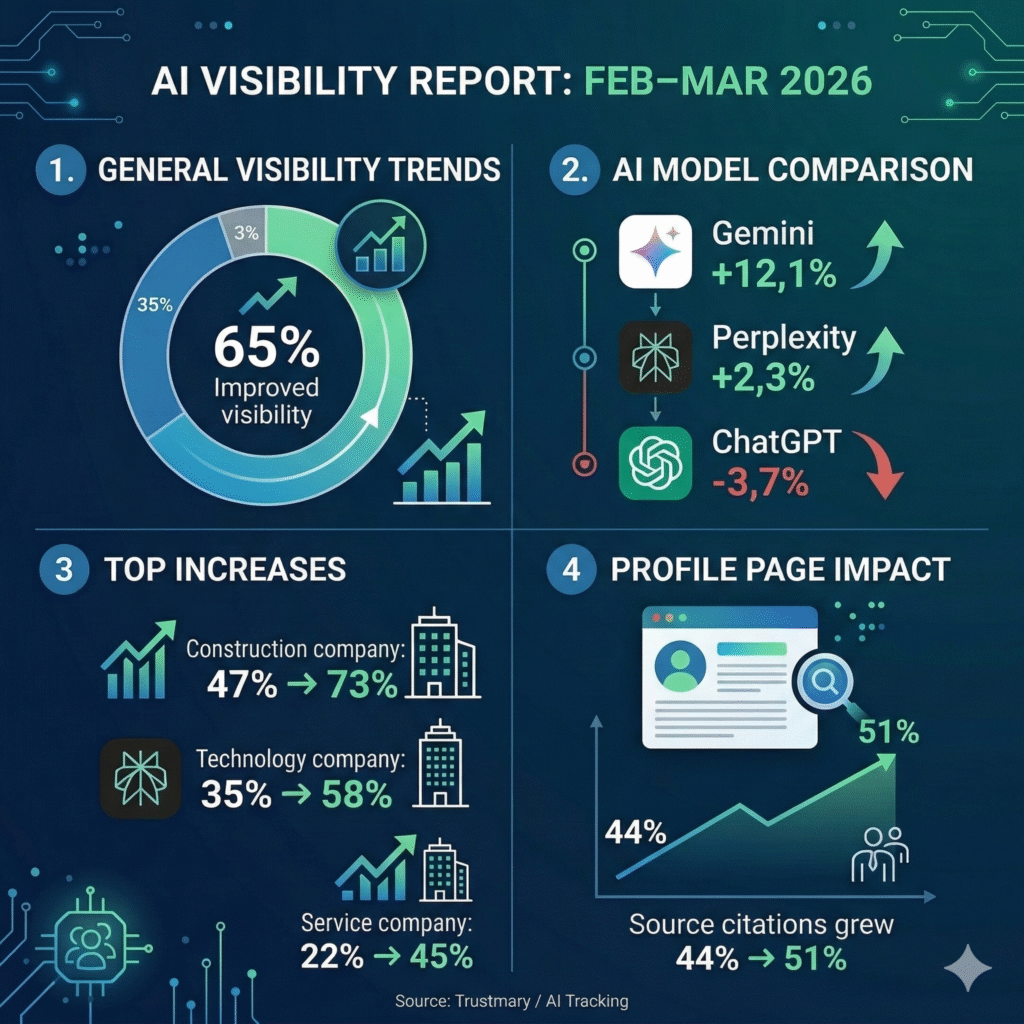
The ability of businesses to influence the answers provided by AI has improved rapidly. Of the 37 companies in the long-term monitoring, as many as 65% managed to increase their visibility in generic searches in just a few weeks.
The ability of businesses to influence the answers provided by AI has improved rapidly. Of the 37 companies in the long-term monitoring, as many as 65% managed to increase their visibility in generic searches in just a few weeks.
HOX: "Generic searches" refer to searches in AI chats that do not ask for information about a specific brand, but rather about a businesses category in general.
While almost every company is mentioned in a brand search in AI models, the real competition is at the "generic level" - when a customer asks, for example, "who is the best HVAC contractor in my area?".
Fastest risers and differences by model
The results show that AI models respond differently to optimisation. In particular, Gemini has proven to be very responsive to changes in web content, with an average increase in visibility of 12.1 percentage points.
- Gemini: The fastest reactor, actively updates its knowledge base. Average improvement in visibility 12.1%.
- Perplexity: steady growth (+2.3% points), leveraging real-time online sources effectively.
- ChatGPT: The most challenging and varied. Relying heavily on its internal data, making it the most important long-term optimisation target. But when the ChatGPT bot finally visits a company's profile page, visibility can increase significantly even in the short term.
Results in weeks
The monitoring revealed impressive successes in a short period of time:
- A construction company increased its visibility from 47% to 73% in just three weeks.
- A real estate operator made a complete breakthrough on Gemini: visibility jumped from 0% to 70% in four weeks.
- An HVAC company went from complete invisibility to a major player in two different AI models in less than a month.
What explains the growth?
One of the most important factors behind this visibility is the AI-optimised Profile page. The tracking showed that when a company has a clear and up-to-date profile page, its use as a referral source increased for 66% of the companies tracked.
The core message: everyone is already in on the branded bids, but the real growth gains will be made in the generic bids. It takes consistent effort, but as recent figures show, results are starting to show in just a few weeks.
What happened in our pilots? Concrete results
Let's look at the individual early pilots in a little more detail. These tests had already been carried out before the broader monitoring described above.
We have built AI-optimised profile pages, specifically designed for AI searches.
The pages contain
- structured data about the company
- an analysis of its customer reviews and feedback
- personalised content to help AI understand the company's strengths and services.
The idea is to make the AI's job as easy as possible: when it looks for an answer to a user's question, all the relevant information is ready in one place.
We have systematically monitored the visibility of our pilot clients on ChatGPT, Perplexity and Gemini before and after the optimisation. We used a standard set of questions to measure how often the company was mentioned, how it was mentioned, and whether Trustmary was used as a source. Here are the key findings:
Visibility on ChatGPT increased by up to 60 percent
At baseline, the company was mentioned five times in ChatGPT responses to a specific set of questions. After optimisation, there were eight mentions, an increase of 60%.
This is a significant change, given that this is a completely organic visibility in AI searches.
More important was the way the company was described.
In the past, it was one option among others, often at the bottom of the list. After optimisation, it often became the first or "most popular" option in categories such as luxury services, tailor-made experiences and the premium segment.
AI began to understand the positioning of the company and was able to recommend it to the right customers.
From zero to full visibility in Perplexity
Another pilot customer did not appear in Perplexity's responses at all before the optimisation.
The company had been in business for years and had good Google reviews, but Perplexity did not identify it as a relevant alternative at all.
In the January 2026 measurements, the same company was found in almost every response to a relevant search.
Perplexity identified the company as a trustworthy operator and highlighted both the company's own website and external review services.
This is critical because Perplexity also shows the user the sources, and the review page as a source adds credibility. The user can click on the source and see for themselves what customers are saying. This builds trust in a way that a company's own website alone cannot.
AI started quoting accurate figures and qualitative feedback
One of the most interesting findings was how the quality of AI responses changed.
Before optimisation, the answers were generic: "Company X is a good option." These types of answers do not help the user to make a decision. They are just a list of alternatives without justification.
After optimization, ChatGPT and Perplexity started to highlight concrete figures: "The company has 171 reviews and an average score of 4.87/5."
Responses also included qualitative information such as"customers praise the transparency and speed of service" or"particularly good feedback on the responsiveness of customer service".
This change is significant. When AI can provide concrete reasons for its recommendation, it is much more persuasive and more likely to result in contact. The user gets an answer that helps them make a decision, rather than having to search for more information themselves.
Visibility doubled in certain categories
In the third pilot, we specifically monitored the visibility of certain categories.
In these categories, the visibility doubled: previously one mention in the question set, after the optimisation two mentions.
In percentage terms, the increase was 100%, but in absolute terms the numbers are still small. This demonstrates that the market is currently very new and it's early changes.
Of particular interest was the fact that the company remained more involved in follow-up questions. When the user first asked a broad question and then elaborated on it, the company remained in the answers. Previously, it dropped out in follow-up questions.
This suggests that AI's understanding of the business deepened with optimisation.
How do AI bots work? The technical perspective
One of the biggest insights from the pilots was how actively the bots of the AI tools were reading the review pages. This was not something we took for granted. We initially assumed that AI models mainly use static training data. The reality is different.
We monitored the logs of one pilot client's Trustmary profile page. ChatGPT's browser bot (ChatGPT-User) visited the page 24 times during the month.
This correlated directly with the fact that Trustmary started to appear as a source of AI responses. Bots are actively crawling review pages and using them as a source of responses in real time.
At baseline, Trustmary was not mentioned at all as a source of AI responses. By the end of the monitoring period, the Trustmary page had already been cited four times: three times on ChatGPT and once on Gemini.
What you have found is concrete evidence that the review site was beginning to act as a reliable source in the eyes of AI.
This tells us a few important things:
- AI bots actively crawl review sites, not just companies' own websites. If your review page is well built, AI will find it and use it.
- Sites with a high domain rating are given more weight. Trustmary's DR 83 means that Google and AI tools consider the site to be a trusted source.
- Structured and analysed data is more valuable to AI than a raw stream of reviews. When data is pre-structured, AI can more easily extract relevant information from it.
- Indexation is continuous. AI bots do not visit the page once, but return regularly. That's why it's important to continuously collect reviews and update the page.
In practice, this means that simply collecting Google reviews is not enough. Reviews must also be in a format that AI can easily read, analyse and cite.
While Google Business Profile reviews are important, they are not optimal for AI searches. They are scattered, and their structure is not AI-friendly.
What should businesses do now?
AI search visibility is still a new field, and most companies have not done anything about it. This is both a challenge and an opportunity: those who act now will have a significant head start. When competitors wake up in a year or two, the frontrunners will have already built a strong position in AI search results.
I recommend starting with these concrete steps:
1. Find out what the current situation is
Open ChatGPT, Perplexity, and Gemini. Ask them questions that your potential customers might ask: "Best company in [your industry] in [your location]?", "Who should you buy [your product/service] from?", "Experiences with [your company name]?" Also, try follow-up questions and different formulations.
See if you can see the answers. If so, how are you described? Is the information correct? If not, which competitors are shown? What are they doing right? This will give you an idea of your starting position and what needs to be improved.
2. Collect and structure reviews
Simply collecting reviews is not enough. They need to be in a form that the AI can understand. Scattered reviews across platforms won't help if the AI can't associate them with your business. You need a centralized place where reviews can be easily read and analyzed.
This means in practice:
- A centralised page where reviews are easy to read and clearly linked to your business
- Clear structure: rating, date, review content, reviewer details, all in an easy-to-extract format
- Summaries and analyses: average, trends, frequently mentioned strengths and areas for improvement. AI appreciates pre-analysed data
- Cross-linking to the company website, Google Business Profile and other relevant sources. This helps the AI to understand the big picture
3. Optimise content for AI
AI tools try to answer the user's question directly. They don't want to give vague answers, they want concrete information. Think about what questions your customers are asking and make sure your review page answers them clearly:
- What services do you offer? (clear list, no long prose)
- In which region do you operate? (cities, regions, postal codes if applicable)
- What do customers say? (analysed reviews, trends, direct quotes)
- What sets you apart from your competitors? (strengths based on data, not marketing speak)
- How can I contact you? (clear contact details, how to get in touch)
4. Publish on a high authority site
The domain rating of a website has a significant impact on how AI will react to its content. Your review page should be on a site with a high DR. This could be your own site (if it has good authority), or an external platform such as Trustmary.
Trustmary's domain rating is 83, which means that Google and AI tools consider it a trustworthy source. When your review page is on such a site, the threshold for AI to cite it is lower.
5. Monitor and iterate constantly
AI visibility is not a one-off project. AI models will update, competitors will wake up and customer search behaviour will change. Build a process to regularly monitor how your business is performing in AI searches and make the necessary changes.
In practice, this can mean a monthly check: you ask the same questions with AI tools and see if visibility has changed. If a competitor has moved ahead, you analyse what they're doing and react. If your own visibility has improved, you document what worked.
Summary: Now is the time to act
AI search is no longer a thing of the future, but of today.
More and more potential customers are asking ChatGPT or Perplexity for recommendations before making a purchase decision. If your business doesn't show up in these responses, or shows up poorly, you're losing customers to competitors who do.
In our pilot projects, we have seen that reviews are key to AI visibility.
When reviews are structured correctly and published on a high-authority site, visibility can increase significantly, from zero to full visibility in a matter of weeks or months.
A 60% increase in visibility on ChatGPT, a doubling on Perplexity, a rise in tangible numbers and qualitative feedback on AI responses. These are results that have a direct impact on the business.
The biggest mistake you can make now is to wait.
Your competitors are probably not awake yet, but that is changing fast. Those who act now are building a lead that will be hard to catch up with. And as AI search becomes more widespread (which is inevitable), the value of that lead will only increase.
If you would like to discuss how AI visibility could work for your business, please contact us. We'd be happy to take stock of your current situation and tell you how to get started. You can also get started yourself: open ChatGPT and ask what it says when someone searches for an actor like your company. The answer might surprise you.


